

Reading time: 17 min
Key takeaways
- NY DMV insurance codes are carrier identifiers, not policy numbers. The three-digit code tells you which company issued the policy — nothing about whether it is active or what it covers.
- The DFS lookup is the fastest path from code to company. Match the three digits, then cross-check the NAIC number and the official claims phone before you dial.
- A valid code does not prove active coverage. Confirm policy status separately with the insurer, the ID card dates, and DMV records.
- Missing or wrong codes have a clear escalation path. Insurer first, then the DFS DMV Code Mailbox, then the DMV if a notice is involved.
What Are NY Insurance Codes?
NY insurance codes are three-digit numbers assigned by the New York State Department of Motor Vehicles to identify licensed auto insurance carriers. They appear on New York insurance ID cards, certificates, and accident reports. The DMV and law enforcement use these codes to verify coverage and monitor registered vehicles.
Let me be direct: almost every misunderstanding I encounter about NY DMV insurance codes starts with one wrong assumption — that the code is a policy reference. It is not. It is a shorthand for a company, and that distinction matters every time you file a claim, talk to a body shop, or answer a letter from Albany.
Two terms worth defining up front. The Insurance Company Code (ICC) is the industry label for what the state prints as a three-digit insurance code New York drivers see on their cards — same number, two names. The Insurance Information and Enforcement System (IIES) is the DMV database that stores which carrier is attached to which vehicle registration. When an officer runs your plate at the roadside, IIES is what answers.
Three-Digit DMV Code vs. Policy Number
A policy number identifies your individual contract. It is alphanumeric, usually long, and unique to you. The three-digit code identifies the carrier that issued that contract. Two drivers with completely different policies from the same insurer share the same three-digit code — and that is by design.
Here’s what most people miss: the code is a routing label, not a status flag. It does not say whether your premium is paid, whether your policy lapsed last Tuesday, or whether your coverage limits are state minimum or full tort. Those answers live in the policy itself and in the insurer’s system, not on the card.
Where the Code Appears on a New York Insurance ID Card
On a standard New York auto insurance ID card, the code sits next to or directly beneath the company name, usually in a small box labelled “Code” or “Ins. Co. Code.” It is three digits, occasionally with a leading zero. If you see a five-digit number nearby, that is almost certainly the NAIC number, not the DMV code. Two numbers, two purposes, one card.
Why the DMV and Law Enforcement Use These Codes
New York requires every registered vehicle to carry liability coverage. The DMV needs a fast, standardized way to confirm which insurer stands behind a given plate. A three-digit code is quicker to enter and less error-prone than a full company name — especially for a patrol officer typing on a mobile terminal in the rain.
In my experience across Europe, most countries solve this with a national database keyed to the plate, and the officer simply reads the result back. New York’s approach is more transparent to the consumer: the code is printed on your own card, so you can see exactly what the state sees. That is a small but real consumer-protection advantage.
| Identifier | Who assigns it | Format | Main use | Where to find it |
|---|---|---|---|---|
| NY DMV insurance code (ICC) | New York State DMV | Three digits (e.g., 453) | Identify the carrier on registrations and ID cards | ID card, certificate of insurance, MV-104, DMV letters |
| NAIC number | National Association of Insurance Commissioners | Five digits (e.g., 22195) | National licensing, reporting, regulatory lookup | ID card, DFS list, insurer filings |
| Policy number | The insurer | Alphanumeric, varies by carrier | Identify your specific contract | ID card, declarations page, billing statements |
Now that the identifier is clear, the practical question becomes where to physically locate it on the paperwork in front of you.
How to Find and Read Your NY Insurance Code
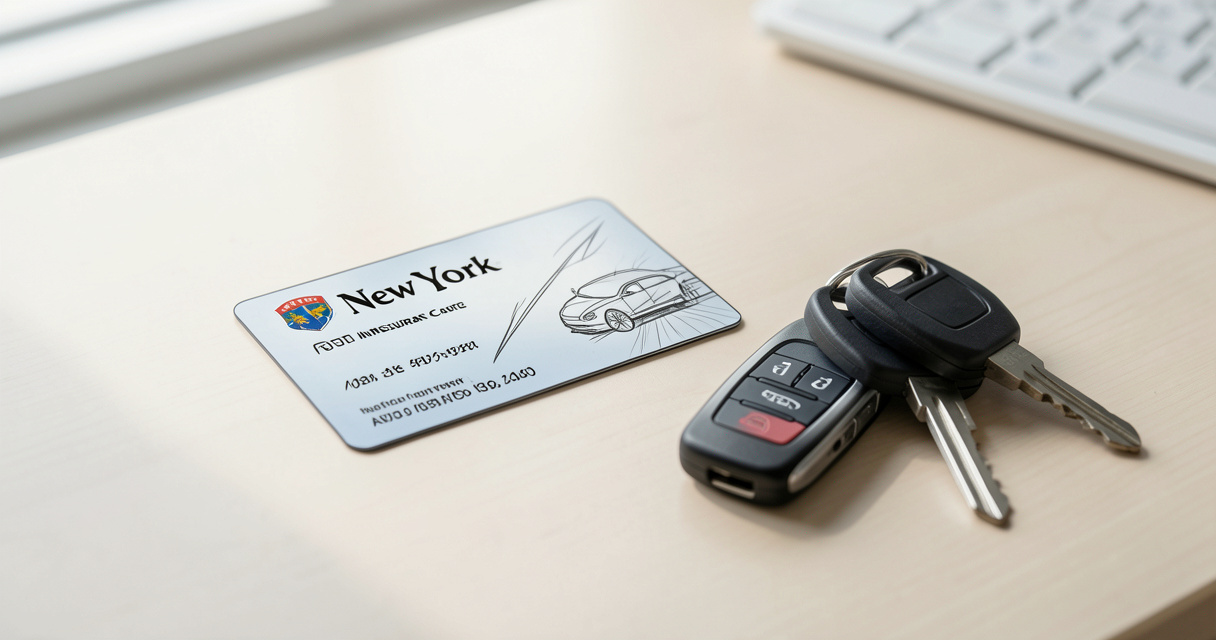
The NY insurance ID card code sits in a fixed spot on every compliant card, but carriers format their cards differently — and after a merger or rebrand, the layout shifts. Here is where to look, in the order I would check if someone handed me a folder of paperwork.
On a New York Auto Insurance ID Card
Look at the top third of the card, near the company name and logo. The three-digit code typically appears in a small box or follows the words “Ins. Co. Code.” On some cards it runs vertically along the left margin. If your card shows a barcode or QR code, the code is still printed in plain digits — scanners are a backup, never the primary reference you rely on in an argument.
On an Accident Report or DMV Letter
On form MV-104, the New York accident report, the insurance section records the company name, the NY accident report insurance code, and the policy number. New York requires an MV-104 filing with the DMV when damage exceeds $1,000 or anyone is injured, per the New York State Department of Financial Services (accessed October 2026). That threshold catches far more collisions than most drivers expect — a two-panel dent and a cracked bumper will often clear it easily.
DMV letters — suspension warnings, insurance lapse notices, registration orders — repeat the same code so you can match the letter to the carrier. If the code on the letter does not match your current ID card, that mismatch is the very first thing to raise with your insurer. Do not wait until the suspension date.
If the Code Is Printed but Hard to Read
Small print, faded thermal paper, and photocopies degrade three-digit codes quickly. Never guess between a 3 and an 8, or a 1 and a 7. Photograph the card under natural light, zoom in, and if the digits are still ambiguous, call the insurer and ask them to read the code back to you. Get the name of the person who confirms it.
- Insurance ID card — top section, near the company name
- Certificate of insurance — issued for a specific vehicle or fleet
- Accident report (MV-104) — insurance section, next to the carrier name
- DMV notice or order — repeat of the code the state currently has on file
- Insurer correspondence — declarations page, renewal letter, or claims acknowledgment
Read this twice. The three-digit code identifies the company. It does not identify your policy, your coverage limits, or whether your premium is current. A code that matches is not the same thing as coverage that is active — and confusing the two is exactly how people end up uninsured at the worst possible moment.
Once you have the digits in front of you, the next step is turning them into a company name and a working phone number.
NY Insurance Code Lookup: How to Match a Code to an Insurer
A DMV insurance code lookup is a three-step process, and skipping the third step is the most common mistake I see. Match the code, confirm the company name, then verify the contact details against the official source before you call. Miss any step and you risk spending an hour on hold with the wrong department.
Step-by-Step DFS Code Lookup
The New York State Department of Financial Services publishes the DFS insurance code list in cooperation with the DMV. It is a single table of carriers, three-digit codes, NAIC numbers, and claims contact information. Search the page for the three-digit code, then read straight across the row.
- Open the DFS DMV Codes and Contact Information page.
- Enter the three-digit code using your browser’s find function.
- Confirm the company name matches the one on your ID card.
- Compare the NAIC number on the list with the one printed on your card.
- Use only the phone number and address printed on the DFS list — never a number from a random search result or an old correspondence.
Cross-Checking the NAIC Number and Contact Details
Here is a worked example. Insurance Company of Greater New York is assigned DMV code 453 and NAIC code 22195, according to the New York State Department of Financial Services (accessed October 2026). If your ID card shows 453, the row should show the same company name and the same NAIC number. Any mismatch is a red flag worth investigating before you authorize a repair or accept a settlement.
| DMV code | NAIC code | Company | Claims contact | Phone | Address |
|---|---|---|---|---|---|
| 453 | 22195 | Insurance Company of Greater New York | Claims Department | As printed on the official DFS list | As printed on the official DFS list |
I keep those contact columns deliberately framed that way. Phone numbers and addresses change with every reorganization, and a stale number routes you to a call center that cannot see the file. The DFS list is the version the state itself relies on — treat it as the source of record.
What the 90% Market-Coverage Figure Means
The DFS list of New York automobile insurance companies represents 90% of the private passenger automobile insurance marketplace by premium volume in New York State, according to the New York State Department of Financial Services (accessed October 2026). That is broad coverage — but it is not universal, and the remaining 10% is where most lookup headaches live.
To put it plainly: nine out of ten premium dollars in the New York private passenger market trace back to a carrier on that list. If your code is not there, you are probably dealing with a small regional carrier, a commercial-only insurer, a newly licensed company, or a code that changed after a merger.
I once watched a claims adjuster at a partner body shop spend forty minutes on hold with the wrong carrier because a three-digit code had been transcribed as 543 instead of 453. One transposed digit, one wasted morning, one delayed repair authorization. If I were filing this claim myself, I would read the code aloud twice from the card and once from the screen before dialing.
Once the code is confirmed, the remaining confusion is almost always about which of the three numbers on the card you should actually quote.
DMV Code vs NAIC Number vs ICC: Key Differences
The NAIC code vs DMV code distinction eliminates most of the confusion I see on claim forms. They are two different numbers assigned by two different bodies for two different purposes — and using one where the other is expected slows everything down, sometimes by days.
Who Assigns Each Number?
The New York DMV assigns the three-digit code. The National Association of Insurance Commissioners assigns the NAIC number, a five-digit identifier used nationally for licensing, financial reporting, and regulatory lookup. Your insurer assigns the policy number. Three issuers, three audiences, three purposes.
The ICC — Insurance Company Code — is not a third number. It is the industry’s name for the same NY DMV insurance code. On a New York document, “ICC,” “Ins. Co. Code,” and “DMV code” all point to the same three digits.
Short version. ICC = New York three-digit code. NAIC = national five-digit code. Policy number = your contract. If a form asks for a “company code” in New York, it almost always wants the three digits.
Which Number Should You Give an Insurer or Repair Shop?
When a repair shop or an insurer asks for the “insurance company code,” they want the three-digit NY DMV code. When a regulator or a national database asks for the NAIC number, give them the five digits. When anyone asks for the policy number, give them the alphanumeric string on your card — that is the one that opens your file.
The safest habit: have all three ready. I keep a photo of my own card in a password-protected folder with the code, NAIC, and policy number legible. It takes ten seconds at the roadside instead of twenty minutes on the phone.
Why the Same Carrier Can Have Multiple Identifiers
Large groups write through multiple licensed subsidiaries. Each subsidiary has its own NAIC number, and in New York each may carry its own three-digit code. If your policy moves from one subsidiary to another during a renewal or a book transfer, your code can change even though the brand on the envelope does not.
| Identifier | Assigning body | Format | Primary use | Where to find it |
|---|---|---|---|---|
| NY DMV code (ICC) | New York State DMV | Three digits | Carrier identification on NY documents | ID card, MV-104, DMV notices |
| NAIC number | NAIC | Five digits | National licensing and regulatory lookup | ID card, DFS list, filings |
| ICC | New York State DMV | Three digits | Same as NY DMV code | Same as NY DMV code |
| Policy number | The insurer | Alphanumeric | Identify your contract | ID card, declarations page |
Knowing which number is which is the easy part. The hard part is what happens when the code you have does not match the code the system expects.
What to Do If Your NY Insurance Code Is Missing, Wrong, or Unrecognized
If your NY insurance code is not listed on the DFS table, or the code on your paperwork is wrong, do not improvise. There is a defined escalation path, and following it in order saves you days. I have seen this go wrong too many times when people start with the DMV instead of the insurer.
Code Missing From an ID Card or Certificate
A compliant New York ID card should show the code. If it is absent, call the insurer and request a corrected card. Do not accept a verbal code over the phone as your permanent record — ask for a reissued card or a written confirmation you can keep in the glovebox.
Code Not Found in the DFS List
Start with the insurer. Ask which three-digit code they have on file for your policy and which legal entity issued it. If the insurer confirms the code and the DFS list does not show it, the DFS DMV Code Mailbox is the next stop — include the NAIC number, the DMV code, the company name, and the contact information so the correction can be processed without a round trip.
Wrong Code on an Accident Report or DMV Notice
An accident report is a statement of what was recorded at the time, not an immutable record. If the code is wrong, ask the insurer to send a corrected insurance confirmation to the DMV, and keep the correspondence. For a DMV notice, respond within the stated deadline and attach proof of coverage — the code correction usually follows the coverage proof, not the other way around.
Insurer in Liquidation or Name Change
A carrier that has been renamed, merged, or placed into liquidation can leave an outdated code on old paperwork. In that situation the code still points to the successor entity or to the liquidator handling claims. The DFS maintains current information on licensed carriers and liquidation notices, and that is where the trail should be picked up.
A client of mine had an MV-104 showing a code that no longer existed after a book transfer. The insurer confirmed the successor entity in one call, sent a corrected confirmation to the DMV, and the lapse notice was withdrawn. Total cost: two phone calls and a scanned document. Total cost if he had ignored it: a suspended registration.
Do not assume a code proves active coverage. Verify policy status with the insurer directly, check the effective dates on the ID card, and confirm what the DMV has on record. A correct code attached to a lapsed policy is still a lapsed policy.
Standard private-passenger policies are the simple case. Special-use vehicles add a layer that catches people off guard.
NY Insurance Codes for Special Situations: Rideshare, Commercial, Motorcycle, and Out-of-State Insurers
A New York commercial auto insurance code may or may not match the code on a personal auto policy, even when the same brand issues both. The code identifies the carrier — the policy form and coverage limits determine what is actually covered. That gap is where most disputes begin.
Rideshare and Delivery Drivers
Uber and Lyft carry commercial auto coverage on their platforms, but that coverage is contingent on app status — off-app, en route, or on-trip. Your personal policy usually excludes commercial use. The code on the platform’s certificate of insurance is the one that matters during an on-trip claim, not the code on your personal card.
Commercial Auto and Fleet Policies
Fleet policies are issued to a named insured entity, often with multiple vehicles and drivers listed. The code identifies the carrier, but the certificate of insurance is the document that proves coverage for a specific vehicle. If a driver is pulled over in a fleet vehicle, the officer may see the registered owner’s carrier rather than the driver’s employer.
Motorcycle and Recreational Vehicles
Motorcycle policies follow the same New York code structure as auto policies, and many carriers write both. The code on a motorcycle ID card is still a carrier identifier. What differs is the coverage structure — medical payments, uninsured motorist, and accessory coverage often vary sharply between auto and motorcycle forms.
Out-of-State Insurers Writing NY Policies
Yes, an out-of-state insurer can have a New York DMV insurance code — provided it is authorized or registered to write primary insurance in New York. Verify with the DFS list and the NAIC number. If a carrier is not licensed in New York, a card showing a NY code should be treated as a serious red flag rather than a paperwork quirk.
- What type of policy is this — personal, commercial, or platform-issued?
- Who is the named insured on the certificate?
- Is there a commercial-use endorsement on the policy?
- Is the carrier authorized to write business in New York?
- Does the code on the ID card match the code on the DFS list?
Special situations sharpen the stakes, but the verification basics do not change. That is exactly why 2026 is a good moment to lock in a routine.
2026 Updates and How to Verify an Insurer’s Legitimacy
New York insurance company verification is a two-minute habit in 2026, and it is the single best defense against fake cards and stale codes. The list is maintained by the DFS in cooperation with the DMV and is updated as carriers merge, rename, enter, or exit the market.
How to Check the DFS/DMV Code List in October 2026
Open the DFS DMV Codes and Contact Information page, search the three-digit code, and confirm the company name and NAIC number. Do this before you authorize a repair, before you accept a settlement offer, and before you respond to any DMV notice. Save a dated screenshot of the row you checked — it costs nothing and settles arguments later.
Red Flags of a Fake or Invalid Insurance Card
Fake cards exist, and they are better than they used to be. The tell is rarely the printing — it is the inconsistency between the code, the company name, and the NAIC number. A card that looks perfect but shows code 453 next to a company that is not Insurance Company of Greater New York is a problem, full stop.
| Red flag | Why it matters | Next step |
|---|---|---|
| Code absent from the card | Compliant NY cards should show it | Request a corrected card from the insurer |
| Company name mismatch on the DFS list | Code may belong to a different carrier | Call the insurer and confirm the issuing entity |
| NAIC number does not match the row | Card may be altered or counterfeit | Verify with DFS before any transaction |
| Liquidation or cease-and-desist notice | Coverage may not be honored | Contact DFS and the liquidator directly |
How to Report a Code Change or Correction
The DFS accepts corrections through the DMV Code Mailbox. A usable report includes the NAIC number, the DMV code, the company name, and current contact information. Send it once, keep the confirmation, and follow up if you do not see the row updated within a reasonable window.
A habit worth building. Save a dated screenshot of the DFS lookup row for your carrier, and always call the insurer using the number on the official DFS list — not the number printed on a card you received from someone else.

Frequently Asked Questions
What is an NY insurance code?
It is a three-digit code assigned by the New York DMV to identify an insurance company authorized to write policies in New York. It is not a policy number and it is not proof of coverage.
How do I find my insurance company code in New York?
Check the insurance ID card, certificate of insurance, accident report, or DMV letter. The code usually appears near the company name, in a small box labelled “Code” or “Ins. Co. Code.”
Is a NY DMV insurance code the same as an NAIC number?
No. The DMV code is a state three-digit identifier; the NAIC number is a national five-digit identifier. Use both together to confirm you are speaking to the right carrier.
How do I look up a New York insurance code?
Match the three-digit code in the DFS DMV Codes and Contact Information table, then cross-check the company name, NAIC number, and phone against the row. Never rely on a number from a search result.
What if my insurance code is not listed?
Call the insurer first and confirm which code and legal entity are on the policy. If the code is still missing or outdated, contact the DFS DMV Code Mailbox with the NAIC number, DMV code, company name, and contact details.
Does a valid NY insurance code prove I have active coverage?
No. The code identifies the carrier, not the policy status. Confirm active coverage with the insurer, the effective dates on the ID card, and the records the DMV holds.
Can an out-of-state insurer have a New York DMV insurance code?
Yes, if it is authorized or registered to write primary insurance in New York. Use the DFS list and the NAIC number to verify before you rely on the card.
The Bottom Line on New York Insurance Company Codes
Four things matter more than anything else in this guide. Let me restate them plainly, because the details fade and the principles should not.
- NY DMV insurance codes identify carriers, not policies or coverage status. A matching code tells you who issued the policy; it does not tell you whether the policy is alive.
- Use the DFS lookup and cross-check the NAIC number and official contact details. Two minutes of verification prevents hours of hold music.
- Missing, wrong, or unrecognized codes have a clear escalation path. Insurer first, then the DFS DMV Code Mailbox, then the DMV when a notice is involved.
- Special situations and 2026 verification steps matter. Rideshare, commercial, motorcycle, and out-of-state policies each carry their own coverage questions that the code alone cannot answer.
The reality is straightforward: the code is a key, and like any key, its value depends entirely on the door it opens and whether that door is still locked to the right company. I have seen drivers win claims because they checked the code before they signed a repair authorization — and I have seen drivers lose weeks because they trusted a number they never verified.
Before you file a claim, authorize a repair, or respond to a DMV notice, ask yourself: does this code match the carrier on the official DFS list, and have I confirmed active coverage?

Twelve years inside the claims industry taught me one thing: most people leave money on the table simply because they don’t know the rules. EuroClaim exists to change that — practical guides, no jargon, no insurance PR.